
Introduction
Surgical sutures are core sterile disposable medical devices for all surgical and cosmetic procedures, serving to rejoin incised tissues, reduce wound tension, and accelerate wound healing. For global medical distributors, hospital procurement teams, and clinic operators, selecting reliable absorbable and non-absorbable sutures directly impacts clinical safety, patient satisfaction, and long-term business profitability.
Both absorbable and non-absorbable sutures have unique material characteristics and applicable scenarios. However, many overseas buyers frequently encounter universal sourcing pain points: unstable product quality, high tissue rejection rates, insufficient antibacterial performance, complicated clinical operation, incomplete certification, and lack of customized support. These issues easily lead to clinical complaints and after-sales losses for medical merchants.
This article professionally compares absorbable and non-absorbable sutures in material composition, clinical applications, and industry defects. More importantly, it focuses on how QS Medical, a professional China-based surgical suture manufacturer, solves common industry pain points with standardized production, patented technology, and full qualification support, providing high-cost-performance, compliant, and customizable suture solutions for global B2B medical buyers.
1. Core Difference Between Absorbable & Non-Absorbable Sutures
The fundamental difference lies inin-vivo degradation performance and long-term tissue support capacity.
| Item | Absorbable Sutures | Non-Absorbable Sutures |
| Degradation Method | Hydrolysis / enzymatic degradation, fully absorbed by human body without foreign body residue | No degradation, remains stable in human tissue for long-term support |
| Need Removal | No need for suture removal, reduce patient secondary trauma | Requires manual removal after wound healing |
| Tensile Retention | Short-term stable support (28–180 days), matching routine tissue healing cycle | Permanent & stable high tension support for high-load tissues |
| Best For | Deep tissue, visceral surgery, cosmetic & pediatric surgery | Skin surface, tendon, vessel, orthopedic and cardiovascular surgery |
2. Absorbable Sutures: Composition, Uses & Existing Problems
2.1 Main Materials & Classification
Absorbable sutures are categorized into natural and synthetic types. Synthetic absorbable sutures dominate modern clinical use due to lower rejection rate and stable degradation cycle.
- Natural absorbable sutures: Catgut, collagen sutures
Degradation cycle: 2–4 weeks; disadvantage: unstable absorption, high tissue irritation - Synthetic absorbable sutures: PGA, PGLA (PGA+PLA), PDO
Degradation cycle: 60–270 days; advantage: controllable degradation, low allergy rate
2.2 Common Application Scenarios
- General surgery: gastrointestinal anastomosis, hepatobiliary surgery
- Gynecology & Urology: uterine repair, fallopian tube and bladder surgery
- Plastic & Aesthetic surgery: facial surgery, double eyelid, minimally invasive cosmetic operation
- Pediatric surgery: avoid suture removal pain and children’s resistance
- Laparoscopic & minimally invasive surgery
2.3 Industry Pain Points of Absorbable Sutures
- Unmatched absorption cycle: Ordinary absorbable sutures degrade unevenly; slow degradation occurs in diabetic and immunocompromised patients, triggering long-term foreign body reaction and clinical complaints.
- Insufficient early tensile strength: Low-grade sutures lose tension rapidly, easily causing wound dehiscence and increasing medical risk for hospitals and clinics.
- High infection risk: Common multi-strand braided sutures have gaps that easily hide bacteria, raising postoperative infection rates and after-sales pressure for buyers.
- Tissue inflammation & rejection: Impure raw materials lead to frequent redness, swelling and induration, affecting patient reputation and repeat purchase rate of medical institutions.
3. Non-Absorbable Sutures: Composition, Uses & Existing Problems
3.1 Main Materials & Classification
- Natural non-absorbable: Silk suture — soft and easy to knot, but obvious tissue reaction
- Synthetic non-absorbable: Nylon, Polypropylene (Prolene), Polyester, Stainless steel wire — high strength, stable performance, low irritation
3.2 Common Application Scenarios
- Epidermal skin suturing for most routine surgeries
- High-tension scenes: tendon repair, abdominal fascia, joint capsule suture
- Vascular anastomosis and cardiovascular surgery
- Orthopedic fixation and ligament reconstruction
- Suspension and fixation for cosmetic lifting surgery
3.3 Industry Pain Points of Non-Absorbable Sutures
- Secondary suture removal required: Traditional non-absorbable sutures need manual removal, increasing hospital manpower costs and patient discomfort.
- Knot reaction & scar hyperplasia: Bulky subcutaneous knots easily cause chronic inflammation, sinus tract and obvious scars, failing cosmetic surgery demands.
- Complicated operation & time-consuming: Complex knotting procedures prolong surgery time, reducing clinical efficiency.
- Foreign body residual risk: Unsmooth suture surface and incomplete removal lead to long-term tissue discomfort, triggering medical disputes.
4. How QS Medical Solves Suture Industry Pain Points
As a certified professional surgical suture manufacturer and supplier integrating R&D, production and sales, QS Medical solves core B2B pain points for global buyers: unstable quality, incomplete certifications, high clinical risk, and inflexible procurement terms. We own standardized dust-free workshops and independent R&D laboratories, delivering certified, low-risk, cost-effective suture solutions for distributors, private clinics, and public hospital procurement.
All our surgical sutures comply with international medical standards, with complete CE, ISO13485, ISO9001 certifications, supporting global market sales and customs clearance.
4.1 Solve Infection Risk — Antibacterial Coating Technology
Most ordinary braided sutures have porous structures that breed bacteria easily. QS Medical innovatively adopts uniform triclosan antibacterial coating for all absorbable and braided sutures. The nano-level coating fits the suture body tightly, effectively inhibiting the colonization of common pathogenic bacteria such as Staphylococcus aureus and E. coli.
- Antibacterial rate up to 99.9%
- Valid during the 7–14 days critical wound healing period
- No impact on suture tensile strength and biocompatibility
4.2 Solve Complicated Operation & Knot Reaction — Barbed Suture Technology
To solve the problems of difficult knotting and knot-induced inflammation, QS launches360° spiral barbed sutures (unidirectional & bidirectional).
- Self-anchoring without knotting, shorten operation time by 30%–50%
- No knot compression, greatly reduce scar hyperplasia
- Integral pressing barbed design, maintain intact tensile strength
4.3 Solve Rejection & Mismatched Absorption — Customized Material Formula
Most low-cost sutures on the market have impure raw materials and fixed single degradation cycles, which cannot adapt to different patient groups and surgical scenarios. QS Medical strictly controls raw material purity and adopts customized polymer proportioning technology to solve allergy, inflammation and mismatched degradation pain points fundamentally.
- High-purity medical-grade polymer: Remove impurities and antigen components, allergy rate lower than 0.01%
- Gradient degradation formula: Match tissue healing cycle precisely, maintain 65% strength on day 14 and 35% strength on day 28
- Super smooth surface treatment: Reduce tissue dragging damage and postoperative pain
4.4 Optimize Non-Absorbable Suture Defects
- Monofilament polypropylene sutures: Bacteria-resistant, low thrombotic risk, ideal for vascular surgery
- High-elastic nylon & polyester sutures: Adapt to joint movement, reduce tissue traction
- High-visibility dyeing process: Convenient for surgery and suture removal, avoid residual foreign body
4.5 Full-Category Suture Coverage for All Clinical Scenarios
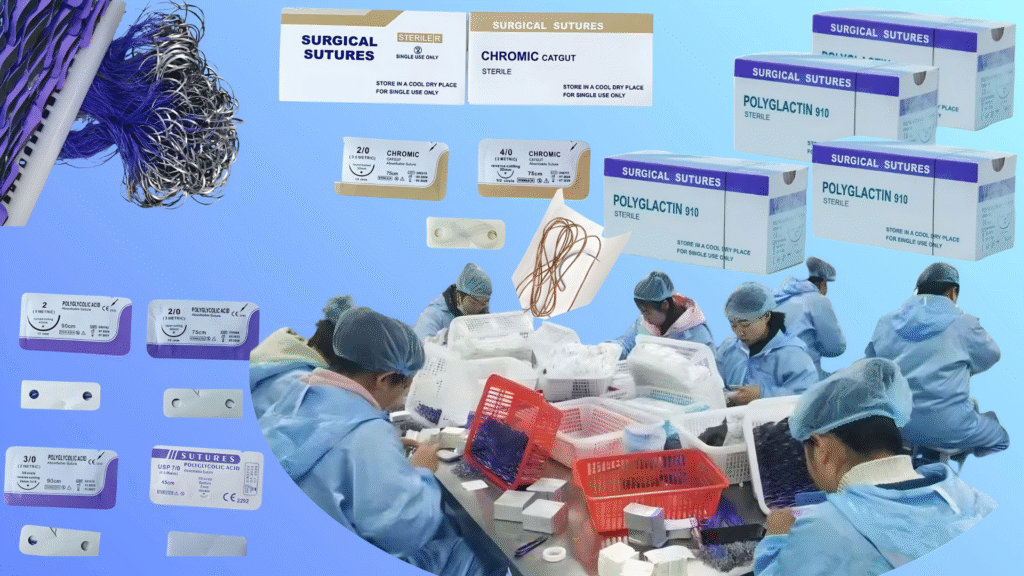
QS Medical supports one-stop B2B procurement and customized services, with a full product matrix covering absorbable, non-absorbable, antibacterial, barbed, ophthalmic, and dental sutures. Our products fully adapt to general surgery, plastic surgery, gynecology, orthopedics, and minimally invasive surgery scenarios. We support OEM/ODM customization, private logo printing, multi-specification batch wholesale, with flexible MOQ and stable delivery cycle for global partners.
5. How to Choose the Right Suture: Clinical Selection Guide
- Fast-healing tissues (mucosa): Rapid absorbable PGA / catgut sutures
- Medium-healing tissues (subcutaneous fascia): Standard PGA910/PGA synthetic absorbable sutures
- Slow-healing & high-tension tissues (tendon/orthopedics): PDO absorbable sutures or non-absorbable polyester/polypropylene sutures
- High infection risk surgery: Priority to antibacterial coated sutures
- Beauty & pediatric surgery: High-precision fine absorbable sutures to avoid scars and suture removal
6. Why Choose QS Medical as Your Long-Term Suture Supplier
Absorbable and non-absorbable sutures are essential consumables for global medical institutions, yet inferior products always bring hidden risks such as infection, rejection, poor healing and clinical disputes. Most small factories only provide single-specification products with incomplete certifications and unstable quality, which cannot support long-term B2B cooperation.
As a reliable long-term partner for global medical buyers, QS Medical relies on high-purity material optimization, patented antibacterial coating, knot-free barbed technology, and precise gradient degradation design to eliminate common industry defects. We insist on standardized production and full-process quality inspection, providing global customers with fully certified, high-stability, cost-effective surgical sutures and flexible customized procurement solutions.
| QUICK B2B PROCUREMENT OVERVIEW (Key Information at a Glance)✅ Complete Certifications: ISO13485, CE Standard | Fully compliant for global customs clearance and hospital bidding✅ Free Sample Service: Full range suture samples free, buyer only pays freight | Shipped within 3–5 working days✅ Flexible MOQ: In-stock standard sutures: 50 boxes minimum; Custom OEM/ODM: 500–1000 boxes (negotiable for long-term partners) | Mixed order supported✅ Fast Stable Delivery: In-stock goods: 3–5 working days; Custom orders: 15–25 working days | Global air/sea logistics support✅ Custom Service: Private logo, OEM/ODM, customized specifications, one-stop medical suture procurement |
�� Instant Inquiry: Get free suture samples, factory wholesale price list, and full product catalog now! Our team provides 24/7 professional B2B procurement support for global medical distributors and hospital buyers.
FAQ
Q1: Which suture is more suitable for bulk procurement for clinic/hospital use?
A1: For cosmetic, pediatric and internal tissue surgery, choose absorbable sutures (no removal needed, less manpower cost). For epidermal, tendon and high-tension surgery, choose non-absorbable sutures (stable long-term tension). We support mixed batch procurement to cover all clinical scenarios.
Q2: Are QS absorbable sutures safe for sensitive patients?
A2: 100% safe. High-purity medical-grade polymers, impurity and antigen-free. Our 0.01% ultra-low allergy rate is far below industry standards, suitable for sensitive groups, diabetics and immunocompromised patients.
Q3: What are the commercial advantages of QS barbed sutures?
A3: Core B2B advantages: 30%–50% shorter surgery time, no knot scarring, higher patient satisfaction. It greatly improves your product competitiveness and profit margins compared with ordinary sutures.
Q4: How long does it take for absorbable sutures to fully dissolve?
A4: PGLA sutures: fully absorbed in 60–90 days; PDO sutures: fully absorbed in 180–270 days. QS controls the degradation cycle stably to match wound healing progress.
Q4: How long does it take for absorbable sutures to fully dissolve?
A4: PGLA: 60–90 days full absorption; PDO: 180–270 days full absorption. Stable gradient degradation perfectly matches wound healing cycle, no premature tension loss or delayed absorption.
Q5: What B2B support can QS Medical provide for global buyers?
A5: One-stop exclusive services: free sample testing, factory direct price, flexible low MOQ, private label OEM/ODM, complete customs certification documents, fast global delivery, 24/7 after-sales technical support.
Q6: Are your sutures certified for overseas market sales?
A6: Fully certified. All products pass ISO13485, CE standard medical certifications, compliant with EU, Southeast Asia, Middle East and most global import & hospital bidding standards.